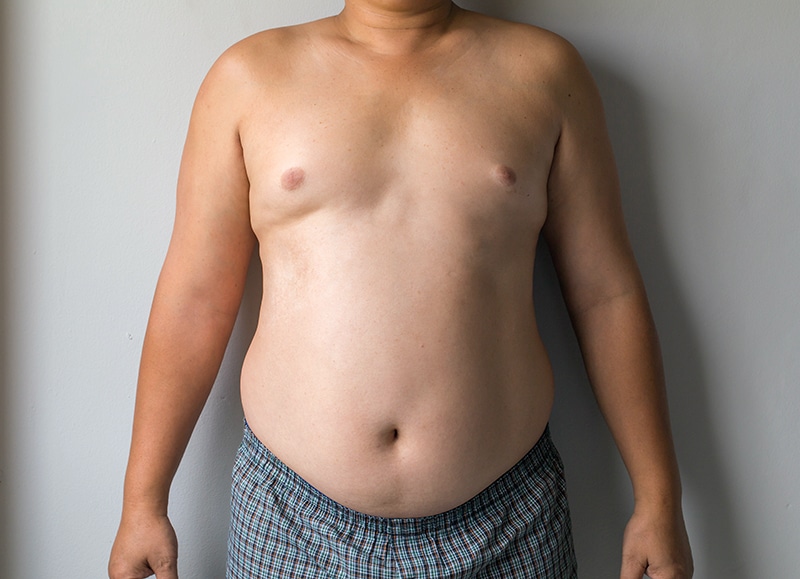
Men are creatures of vanity too. So when their chest looks flabby due to excess fat, more often than not, they resort to the Internet for answers. But beware for the search result could be misleading, albeit unintentionally. Gynecomastia could be a potential cause but bear in mind, it is not so for all cases. Sometimes it is more likely to be “pseudogynecomastia” – a condition brought on by excess fat.
What is Gynecomastia?
Gynecomastia is mainly caused by hormonal imbalance, which is the result of excess estrogen being produced. Changes surrounding sexual development in teenage boys and health issues such as thyroid problems common among men in their 50s and above are some of the causes of this hormonal imbalance. The side effects of some medications are also potential causes.
There are 4 grades when it comes to classifying gynecomastia. The mildest being a local swelling around the nipple area while the most severe is in the form of a rounded appearance akin to the features of a female breast.
What is Pseudogynecomastia?
In men, the fat tends to accumulate in the chest and abdomen areas. Fat amassed around the chest area usually results in a puffy or swollen appearance clinically known as lipomastia, adipomastia, or pseudogynecomastia.
When the body produces excess estrogen, the more the likelihood that excess fat will be stored. Fat also causes the body to produce the aromatase enzyme. This enzyme converts testosterone into estrogen and is responsible for slowing down metabolism, which slows down the body’s ability to burn fat – you will lose fat but in a lesser amount. If not addressed, this can lead to more fat being stored, causing an imbalance to the body’s hormone level.
What causes Pseudogynecomastia?
Although it may appear like gynecomastia – pseudogynecomastia is actually the accumulation of excess breast fat. Nonetheless, the term “pseudo” should not be waved off lightly as the condition is a real problem for men.
What is the difference between Gynecomastia and Pseudogynecomastia?
On the surface, both conditions seem alike in terms of appearance. Gynecomastia, however, is caused by the overdevelopment of glandular tissues. Pseudogynecomastia, on the other hand, is the result of only excess fat accumulated around the chest area.
There are simple self-check methods that one can carry out. For example, if you feel the presence of a firm mound of glandular tissue around the areola area, which is painful to the touch, then chances are you might have gynecomastia. In the case of pseudogynecomastia, the entire chest area is evenly enlarged.
Commonly, An individual can have both gynecomastia and pseudogynecomastia.
It is important to note that only a doctor via a clinical assessment is able to confirm the condition. Not all doctors can diagnose if a patient may or may not have gynecomastia. It is important to look for a doctor with experience in handling gynecomastia cases to identify.
Can I just wear a compression garment to manage my condition?
A compression garment does work – in terms of appearance. The underlying issue has to be addressed appropriately, and the first step is to schedule an appointment with a qualified doctor who is in the best position to advise on the necessary measures.
Treatment for Pseudogynecomastia: VASER® Lipo
A fat and weight loss program involving specific exercises and a change in dietary habits may help reduce or relieve pseudogynecomastia to a certain extent but to completely eradicate this issue is via clinically proven fat reduction procedure such as Vaser Liposuction, which effectively addresses the issue and remove excess fat in the problematic area.
What is VASER Lipo?
VASER (Vibration Amplification of Sound Energy at Resonance) Lipo is a less invasive form of liposuction. Like liposuction, it eliminates unwanted fat, but it does so in a gentler manner by using sound energy to liquefy unwanted fat cells in targeted areas. VASER Lipo targets areas with unwanted fat, leaving surrounding tissues undisturbed. The result is a more contoured and defined appearance.
How does VASER Lipo treat pseudogynecomastia?
As pseudogynecomastia is the result of an accumulation of excess fat, VASER® Lipo due to its prescribed function and precised capability, is ideal in treating the condition. Additionally, it leaves a more defined and natural-looking appearance.
Dr. Delgado is in the operating room today with two cases. One is a standard gynecomastia surgery for a grade 2 patient and the other is a revision surgery. In this video snippet, he shows his technique for the standard gynecomastia surgery procedure.
The gland excision with liposuction is the most common gynecomastia surgery that plastic surgeons perform. Forty-five percent of Dr. Delgado’s surgeries are revision gynecomastia cases, and the most common reason for revision surgery is the original surgeon did not remove the breast gland. Some surgeons feel that a good result can be achieved with liposuction-only, but it does not address the gland component.
Man boobs, or gynecomastia, can be a confidence killer. But it’s not the end of the world. Check Busting 4 Myths of Gynecomastia.
Gynecomastia, or the development of man boobs and excess glandular tissues, can occur when there is a hormonal imbalance or low testosterone levels in men,” explains Dr Ivan Puah. “Being a naturally occurring hormone, testosterone is not only directly responsible for a man’s physical features but also his sex drive and mood.” Here are the Busting 4 Myths of Gynecomastia.
Myths of Gynecomastia #1: Only overweight men can get Gynecomastia
Fact: When there is hormonal imbalance, gynecomastia can strike males of all ages – from infants, adolescents and teens to those aged 50 and older. However, the tenderness and swelling usually recede in a few months to two years, so it’s still possible for some – such as babies and younger males – to forego treatment. “These symptoms are not uncommon during puberty. However, should they persist upon reaching adulthood, surgical intervention is the answer,” relates Dr Ivan Puah.
Other factors that can increase your chances of experiencing a hormonal change or imbalance, and thus gynecomastia, include medications or drugs, alcohol, ageing and other health conditions.
Myths of Gynecomastia #2: Gynecomastia is a sign of breast cancer
Fact: There is a risk, but it is rare. If you do feel any lumps or abnormalities, it’s good to see your doctor for a check-up.
In most cases, gynecomastia will not pose long-term problems or complications. The effects are found to be more psychological due to the change in a man’s appearance.
Myths of Gynecomastia #3: I just need to exercise more to get rid of my man boobs
Fact: If you’re only dealing with pseudogynecomastia or fat build-up on the chest, there are workouts designed to build muscle and promote loss of fat. A healthy diet and a regular exercise programme that includes cardio and interval training, bench presses and weightlifting may help.
But if you have gynecomastia or excess glandular tissues, these lifestyle changes will not guarantee you losing the man boobs. You may want to consider gynecomastia surgery.
Myths of Gynecomastia #4: It’s hard to treat gynecomastia
Fact: “Gynecomastia is often treatable,” assures Dr Ivan Puah. Not only does gynecomastia surgery – one of the clinic’s signature treatments – work towards the permanent removal of excess glandular tissues, it also sculpts and defines the chest area with the promise of a short recovery time.
Add in the High Intensity Focus Ultrasound treatment to tighten sagging skin, and you’ll see even more visible improvements and a better-looking physique.
Gynecomastia Surgery and the “Pull Through Procedure”
DR. DELGADO DISPLAYS THE PULL THROUGH Procedure.
Male breast reduction surgery for gynecomastia is performed in a variety of ways. The specific surgical technique depends on the “grade of gynecomastia” of the patient. The pull-through procedure was developed by Paolo Giovanni Morselli from Italy who publish the original article in the European Journal of Plastic Surgery in 2012. The pull-through procedure has become very popular in the United States due to the small incision.
Pull Through technique Operation
The pull through procedure is performed by making a quarter-inch incision at the bottom of the areola. Liposuction is performed to remove fat from around the breast gland. The tissue is grasped by a special instrument and then pulled through the incision while freeing up the breast tissue from below the areola and above the muscle. This is a blind procedure and not great access so the experience is required, especially to avoid a crater deformity.
FAQ’S
Who is an ideal candidate?
The best candidates are grade 1 or 2 gynecomastia. These patients’ male breast enlargement is not too large and the gland can be removed and the fat blended without creating a crater deformity.
What is recovery?
If drains are used, they are removed in 2-3 days. You can drive a car and perform white-collar work in 5 days. Blue-collar work about 7-10 days. Modified exercise can begin in 2 weeks and full work-outs in 4-6 weeks. A compression vest is worn for 4-6 weeks.
What is the cost of the “pull-through” procedure?
The expense of the surgery is explained in this cost link, but the cost is usually less due to less surgical time. So, looking at $6,000-$7,000 is a normal fee. Sometimes, local anesthesia is used and this would lower the cost.
The silent sufferer of man-boobs Gynecomastia, Men or women, we all have insecurities. Some of us dislike how our arms are a little too thin, while some of us dislike the way that our jawline isn’t as masculine as we wish they were.
All of these insecurities usually come from our comparisons to ‘ideal’ figures presented on the media, and many of the times, these ‘ideals’ are actually just products of awesome Photoshop skills.
Regardless, we make efforts to improve our physical appearances – some through strict exercise regimes, some through undergoing aesthetic procedures, whatever works for each of us.
The latter is riddled with misconceptions, and the term “cosmetic surgery monster” tends to pop up as an insult, and many a times as an unfair exaggeration to the individuals who simply took an alternative route to improve their appearances.
But what if some of these surgeries were actually rooted in health issues?
For example, a bulging belly is more of a health than aesthetic problem.
We’ve probably heard about those who undergo jaw surgery to reduce issues from strong under and overbites, and some who require rhinoplasty to fix breathing problems. However, not much is known about man-boobs gynecomastia, also known as the medical condition of having male breasts.
We spoke to David (not his real name), a Singaporean in his mid-40s, and a silent sufferer of “man boobs” until his gynecomastia surgery.
When It Actually Becomes A Health Problem: Silent Sufferer of Gynecomastia
“Man boobs” also have physical implications, like soreness.
“Man boobs” are commonly seen as an issue when guys are wearing shirts with a tighter fit, and the bulges aren’t in the right places. (Also a problem for women.)
For David, however, the extra fat in his chest was actually making him feel physically uncomfortable.
“I’ve always felt a little discomfort on my chest area in my early 20s but have always passed it off as nothing. It wasn’t until the discomfort started getting overbearing and disrupting my daily activities.”
He first assumed that it was a sign of heart problems, but checks with a doctor revealed no issues, so he turned to the most common trick in the bag – exercise for gynecomastia.
While his regime did help him lose weight, the fats on his chest didn’t go away and the pain was still persisting. He even resorted to putting ice on the sore areas, but it only served as a temporary relief.
Putting A Name To The Condition And Its Solution
Unable to find a solution offline, and adding on to the fact that it’s not a common topic of discussion among Singaporean men, David had no choice but to search online for solutions.
He soon found out that what he had was man-boobs gynecomastia, and eventually, stumbled upon a gynecomastia clinic, which presented an opportunity for him to finally get help for the embarrassing condition.
However, the decision wasn’t as easily made as compared to, let’s say, getting help for an illness like flu.
He was wary about seeking help from a medical aesthetic clinic, especially since cosmetic surgeries are usually cast in a negative light.
“I wouldn’t call it a misconception, [but] more of a lack of understanding. I’ve always thought of aesthetics procedures as solely for vanity and never did I imagine that they could do more.”
However, being that it was a means that he could finally be rid of his suffering, he decided to book an appointment to see how things go.
“You can imagine it’s quite unnerving considering that I have no prior experience personally or by proxy of aesthetic procedures. But with encouragement and relentless persuasion from my wife, I decided to take the first step.”