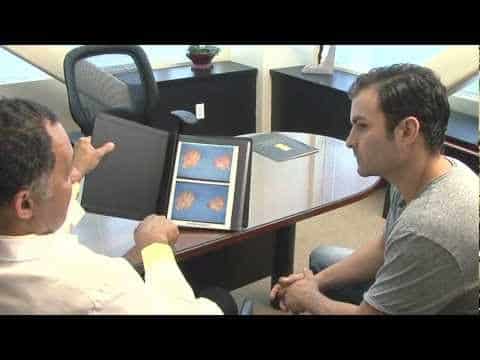
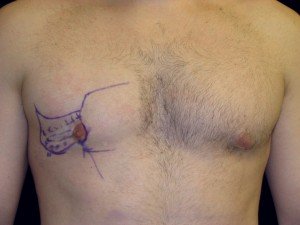
Each case of gynecomastia is unique, while most men have what is considered “true gynecomastia” there are some men with a milder form that offers some options. Men that have “true gynecomastia” usually require both liposuction of fat and surgical excision of the breast gland. This is generally a three to four hour surgical procedure and requires the placing of drains which stay in place for about four days.
Men who have what is referred to as puffy nipples and/or a smaller breast mound of an A or B cup and have good quality skin could potentially be candidates for a less invasive surgery that I refer to as the “light pull through procedure”. It is not a new procedure it has been around for almost twenty years, but it has been perfected through the years with outstanding results.
This procedure differs with traditional gynecomastia surgery in that an endoscope is used. An endoscope is an instrument that is inserted into the body through a small incision of about two to three millimeters at the lateral edge of the areola. The endoscope allows the surgeon to see inside the body via optical fibers that send a picture to a computer monitor. First, fat is removed by liposuction with a cannula through the same small incision. Then, through the same incision the connecting fibers are freed up with a medical instrument that resembles a pickle fork, allowing the glandular tissue to be pulled gently through the incision thus the name “light pull through procedure”.
For my traditional gynecomastia patients, a three millimeter incision is made in the arm pit to remove fat from the chest by liposuction. Then I make an incision around the lower half of the areola to have access to breast tissue for excision. With the incision around the areola where the skin color naturally changes, the scar heals very nicely and usually is not detectable. Once fat and tissue have been removed from the chest a pocket of space is left where fluid can collect, this is referred to as a seroma, different than a hematoma which is a collection of blood from a small artery or vein. To prevent the accumulation of fluid in the pocket I use drains. The drains create a negative pressure encouraging the cavity to close down. In addition, I have my patients wear a compression vest for six weeks. There are several reasons for the vest, for one thing it helps close the pocket of space, reduces swelling and helps the skin to retract.
Contrary to a popular belief that liposuction alone may reduce the male breast, removal of breast tissue is also necessary for a well sculpted outcome. Whether it is by the traditional surgical excision or for those with a minor case who are treated by the “light pull through procedure”, breast tissue must be excised as it is too dense to be removed through the cannula by liposuction. The exception to this would be the patient that has what is known as pseudogynecomastia (which is caused by fat alone).
Since the “light pull through procedure” is so much less invasive, my patients do not require drains. In addition to not needing drains, the other advantages are; the surgical time is less and the recovery time is faster, and with the smaller incision the resulting scar heals to almost invisible.
Ductal Carcinoma in Situ (DICS) means Ductal (duct) Carcinoma (cancer) in Situ (in its original place).
DCIS is the earliest form of breast cancer. The cancer cells are confined to the ducts of the breast and not the surrounding tissue. DCIS is much less common in men than women, and only 7% of breast cancers in men are DCIS.
Most DCIS in men are of the papillary type, which refers to the microscopic shape of the cancer cells which resemble fingers or threads. It is considered stage 0, which is not a life threatening condition; it is non-invasive and can almost always be cured. However, in some cases if left untreated it could develop the ability to spread into the breast tissue surrounding the ducts. Once the cancer cells have spread outside the lining of the ducts or lobules into the surrounding tissue, it is called invasive breast cancer which accounts for 9 out of 10 breast cancer in men.
The exact cause of DCIS in men is unknown, but some causes are believed to be; family history of breast cancer, hormone exposure, alcohol consumption, obesity, lack of exercise, and age.
Most men do not experience any symptoms, but some that do, may notice:
A painless lump under the nipple or areola
Discharge or bleeding from the nipple
An inverted nipple
Rash on the nipple
If any of these symptoms occur, your doctor will most likely send you to a specialist for advice or treatment. If breast cancer is suspected the doctor may order a mammogram, breast ultrasound, biopsy, and blood tests. If the tests are positive, further tests most likely will be ordered to determine where the cancer is and at what stage.
No increase in breast cancer risk has been found associated with gynecomastia. Men are less likely to be diagnosed in the early stages than women, but due to increased awareness of breast cancer in men, early detection at the non-invasive stage has increased.
Not everyone that has DCIS will develop invasive breast cancer but it is impossible to predict who will and who won’t, most surgeons believe the preferred treatment is a customized multidisciplinary treatment plan for each patient.
Dr. Delgado states that out of many hundreds of men he has treated for gynecomastia, only one man who was in his forties, developed DCIS. That patient went on to have further treatment. This is the reason that Dr. Delgado submits breast tissue samples to pathology in most cases. This article is written to heighten the awareness of this issue.
Gynecomastia is a condition that is caused by a hormonal imbalance in the body. While it can develop at puberty for boys, it may or may not resolve itself by adulthood. Specific prescriptions, illegal drugs, or medical conditions such as hyperthyroidism, kidney failure, or cirrhosis of the liver can cause gynecomastia.
As the use of antipsychotic medications in children has become more common, doctors have seen an increase in cases of gynecomastia. Specifically, Risperdal® (risperidone) has been seen to cause gynecomastia in some children and teens that use the drug for behavior issues.
Currently, there is a movement to petition the FDA to ban Risperdal® for use in children and youn7g adults. The petition claims that long-term results have not been studied sufficiently to allow the drug to be used with these patients.
While drugs can cause gynecomastia, there is no drug to reverse the condition. Patients find that diet and exercise often have no effect and can make the condition appear worse by enlarging the chest. In many cases, plastic surgery is the only answer to resolve the condition.
Plastic surgeons often use a combination of liposuction and surgical excision of glandular tissue to correct gynecomastia, depending on the extent of the patient’s problem. Surgery is usually done under general anesthesia and takes about an hour to complete.
The majority of patients describe their recovery as uncomfortable rather than painful. They say they imagined it was going to be worse and compared it to the muscle ache experienced after a difficult gym workout. Even though some bruising and swelling after surgery is normal, most men notice an immediate improvement in their chest contouring.
If you are disappointed with the results of your original male breast reduction surgery and have lost confidence with your Plastic Surgeon, first discuss it with your surgeon and see what suggestions he or she may have. Then get a second opinion from a Board Certified Plastic Surgeon who specializes in gynecomastia surgery. If he or she agrees with your original surgeon you are probably on the right track and the revision may cost you little or nothing.
However, if the original surgery left you with a major defect such as a crater deformity or the surgeon only did liposuction and the other surgeon confirmed that you should have had excision of breast tissue as well, you may need to choose a new surgeon with more experience for a revision. In picking a new surgeon be sure the office staff makes you feel comfortable, you will be relying on them for information and support. If they are not friendly or you sense the tension in the office, go elsewhere!
Needing revision surgery can be more expensive than the original surgery, as now the surgeon has to deal with scar tissue, and the retraction of the skin may have been compromised.
One major cause for gynecomastia revision surgery is when too much of the male breast tissue has been removed leaving what is known as a “crater deformity”. A crater deformity is as it sounds a crater or depression under the nipple/areola complex with the inadequate blending of surrounding tissue for a firm smooth contour.
How to Correct a Crater Deformity
Fortunately, there are procedures that can correct the crater deformity. First, the patient must wait until he has completely healed from the original surgery. In general, the fat flap is the best choice and has become the most predictable; this is where the skin is elevated and the fat that surrounds the crater is sewn together filling in the depression. Sometimes the use of fat injections also known as fat transfer or fat grafting can take place but it all depends on the architecture of the defect.
Find a Board Certified Plastic Surgeon
It is important for the gynecomastia patient to find an experienced Board Certified Plastic Surgeon. A secondary procedure is much more difficult due to scar tissue that has formed which makes the dissection more difficult and healing less predictable. In addition to the complication of scar tissue, the skin usually does not contract as well as the first time around. I would say that 35% to 40% of my gynecomastia procedures are revision surgeries.
See video of “post-surgery” in a blog dated April 2, 2012.